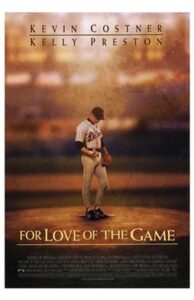
 I first watched Sam Raimi’s (Spider-Man 2, A Simple Plan) For Love of the Game in the fall of 1999. It was the day after Virginia Tech defeated Clemson at Lane Stadium on ESPN’s Thursday Night Football. My dad had come down for the game. The day after, we went to see the Kevin Costner-led (A Perfect World, Field of Dreams) baseball drama. I’m a sucker for films that seamlessly incorporate flashbacks to advance the story better. For Love of the Game did just that, perhaps, at the time, in a way that I hadn’t seen before. 23-year-old me left my viewing thinking that it was one of the top 10-15 movies I’ve ever seen.
Watching it 25 years later (my third or fourth viewing) allowed me to see it from the lens of a film evaluator rather than a first-time viewer with no prior expectations. Similar to some of the other movies I fell in love with as a child or young adult, I either missed or ignored many of the apparent flaws. Raimi attempted to get directly at our heart strings with the story of an aging superstar battling father time physically, while lamenting the life he missed out on as he gave everything to the sport he loved.
Costner stars as Billy Chapel, a 40-year-old pitcher for the Detroit Tigers. His last start of the season is the second-to-last game of the season, and is against the New York Yankees. While the game means nothing to the Tigers, a win for the Yankees would help them win the division over the rival Boston Red Sox. Does that matter for our story? Not really, other than the fact that Chapel’s Tigers have the chance to play spoiler, in an otherwise difficult season. We learn that the team’s owner, Gary Wheeler (Brin Cox – The Ring, the television series Succession) has agreed to sell the team at season’s end and, in a private conversation with Billy, tells him the new owners plan to trade him to the San Francisco Giants, leaving the pitcher with a difficult decision. To leave the only team he has ever known for a new opportunity, or to retire after a 19-year career with the Tigers.

With this, perhaps, being his final game ever and indeed his last in a Tigers’ uniform, Billy has his pitching arsenal going strong early. With his aging catcher, Gus (John C. Reilly – Step Brothers, The Sisters Brothers) regulated primarily as a backup (except during games started by Chapel), Billy rejects Manager Frank Perry’s (JK Simmons – Whiplash, Juror #2) decision to start Gus’s backup. As Billy gets his request, we see that this Face of the Detroit Tigers has clout that his other players don’t. The film is (mostly) told through Billy’s day at the stadium, as he prepares and performs in the game. As Billy “clears the mechanism,” his way of closing out the game’s noise, while focusing on only the batter at the plate, we are taken back five years when Billy first meets Jane (Kelly Preston – Jerry Maguire, From Dusk Til Dawn) and the romantic relationship that ensues. Through other flashbacks, we see many of the events that have led us to this point in time. Watching it as a 19-year-old, I thought about how great it was to see the two characters work through their up-and-down relationship.
Watching it again in my late 40s, I see how convenient it was that the flashback scenes with Jane were either going through an up or down in their relationship, or his”saving her” in some way. The more she pushes him away, the more he wins her over by showing up. The more she cries in front of him, the more pensive he becomes when he’s away from her. At the time of my initial viewing, I thought the film was about them, set against the backdrop of his quest for a perfect game. At the time of my most recent viewing, I realized that this film is all about him. Raimi uses Jane in the same way he uses the game of baseball, as pawn pieces to illustrate how perfect Billy appears externally and how imperfect he is internally. While Raimi wants us to believe that Billy has nothing if he doesn’t have Jane, nothing further can be from the truth. He seems to do just fine without her. Through all his ups and downs, we never believed that Billy was not going to be okay. When he is unkind or cruel towards Jane, he seems to get the benefit of the doubt with his leading man good looks and natural charisma. The idea of a relationship with Jane is something we believe he wants to have, but it pales in comparison to his life as a professional athlete.
While I did love the flashbacks as a way to advance the story to the present day, there were a few moments that were over-the-top or cringeworthy. Whether he was offering advice to a rookie teammate after he made a blunder that made national headlines, helping a teammate move after he signed a big contract to go to a rival team, or diverting the team bus to pick up a stray teenager, Billy was always up for being the hero. That is all to say that while I did appreciate witnessing the highs and lows of their evolving relationship, Raimi laid it on a bit too thick. More than the sap was the number of flashbacks. There were too many. And half of those were to prop Billy even further up his pedestal. Most of it worked for me. However, the defender that I had been on how “perfect” I once thought this movie to be was left back in 1999.

Costner is the ultimate lead actor for sports dramas. With credits that include Bull Durham, Field of Dreams, Tin Cup, Draft Day, and McFarland USA, Costner embodies characters that only a person with a genuine love for sports could bring to life. His love of baseball films, in particular, has led him to a longstanding relationship with Major League Baseball, including occasional appearances on live telecasts. He has long been praised for representing the sport in a way that makes those who have played it proud. His performance as Chapel shows how life outside of baseball affects an established professional athlete.
Despite its all-too-convenient plot devices, I permit myself to revisit my first viewing of For Love of the Game and recall that initial feeling of how poignant the story resonated with me, while prompting me to wonder what I would do in a situation where my work and personal lives were so inextricably intertwined, while realizing the success of one would come at the price of the detriment of the other. The melodrama was laid on thick, but not in the way of a 23-year-old yet to experience the start of a career or the intricacies of an adult relationship. Even watching the film 25 years after its release, I lean more on how I felt during my initial viewing, focusing on those highs rather than on the film’s faults, or even how the movie would be viewed far differently by the majority had it been released in 2025 instead of 1999. For Love of the Game will forever hold a special place in my heart, and I look forward to rewatching it at least once a decade.
Plot 7.5/10
Character Development 7.75/10
Character Chemistry 8.75/10
Acting 8.5/10
Screenplay 8.5/10
Directing 8.25/10
Cinematography 9/10
Sound 8.5/10
Hook and Reel 10/10
Universal Relevance 10/10
86.75%
A-
Movies You Might Like If You Liked This Movie
- Moneyball
- The Rookie
- Slumdog Millionaire
- 127 Hours
- The Natural