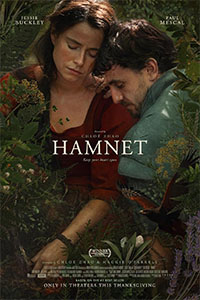
 Hamnet was the one film of the year that you expected to feel the most heartbreaking emotions from. It had all the elements, including glowing reviews from film festivals held months before its release. Though still relatively new to the director’s chair, Chloé Zhao has a penchant for directing a couple of super affecting movies in The Rider and Nomadland, for which she won her first Oscar. Add, perhaps, Hollywood’s next leading man in the already accomplished Paul Mescal (Aftersun, All of Us Strangers, Gladiator II) as William Shakespeare, and equally young and accomplished Jessie Buckley (The Lost Daughter, Beast, Chernobyl) as his wife, Agnes along with the tragic play Hamlet, and this had the formula for a film that would leave an entire audience sobbing by the ending credits. Unfortunately, Zhao never took us there in her tender, though underwhelming Hamnet, the true story of William and Agnes’s son, who inspired Hamlet, perhaps Shakespeare’s most recognized and revered play behind Romeo and Juliet.
Hamnet is by no means a bad movie. But it leaves a lot to be desired. Zhao kept us at an arm’s distance from the rawest emotions of her two lead characters. It was as if she wanted to tell us a story rather than show us one. For a film we thought would revolve around William Shakespeare, the playwright was absent from the screen as much as he was on it. In doing so, Zhao further pulled us away from the emotion that we had all expected to feel.
The film follows the courtship and marriage of Will, a handsome, charming Latin tutor, and Agnes, the daughter of a forest witch with a strict belief system and a strong connection to the elements. It feels like a mismatch of sorts, something that each of their families and friends makes verbally known. While Agnes’s quirks and idiosyncrasies make her appear as a misfit to others, they draw Will even closer to her. There is an innate attraction between these two characters. It becomes apparent to all that the pair will wed, a development accelerated when Agnes becomes pregnant with a daughter, Susanna.
Years later, the couple has twins, a boy, Hamnet, and a girl, Judith. Agnes did not know she was having twins until Hamnet emerged. Right away, the eccentric Agnes feels doomed. She had always had visions of her dying at an old age with two children at the foot of her bed. In her visions, there was never a third child. She shares that the visions of her future death have changed, and she no longer sees her children.

As the family ages, we become engaged in their day-to-day activities. There is genuine adoration and love between all in the family, including Will’s mother, Mary (Emily Watson – The Theory of Everything, On Chesil Beach), and Agnes’s loving and supportive brother, Bartholomew (Joe Alwyn – The Favourite, The Brutalist). Zhao’s primary focus is on Will and Hamnet, with the father showing his young son how to swordfight with sticks and the duties of being the man of the family. There is also a delicate, fascinating metaphysical bond between Hamnet and Agnes.
When he is eleven, the plague kills Hamnet. Will and Agnes’s storybook life is shattered. It’s at this juncture that Mescal and Buckley’s performances should have shone as each tries to process the loss on their own rather than as a unit. Zhao invites us to dwell in their inconspicuous suffering in a way that feels both uncomfortably invasive. Unfortunately, her direction portrays the tragedy in a way that forces itself on us with uncanny, heightened emotion, pulling us from the moment almost as quickly as we entered it.
Instead of grieving with Agnes, Susanna, and Judith, Will pulls away, something he has been prone to do in the past. His work as a playwright and director in London slowly takes precedence over everything else in his life, including his family. As his fame grows in a location far from their home in the woods, so does his connection to the life he once knew. It’s not that he isn’t grieving Hamnet’s death. He certainly is. It is here that we learn one of Shakespeare’s most famous play lines, “To be or not to be,” as Will stands on the river’s edge, seeming to contemplate if he has the will to continue.
The end leaves our two leads coming to terms with the untimely loss of Hamnet. The sold-out crowd is moved to tears while viewing the play’s debut. And while they are viewing the play from two different lenses, with William knowing the play inside and out by watching it, and with Agnes seeing it for the first time, whereas Agnes’s watch is novel, having no idea of the film’s plot until it plays out in real time. While different, it brings closure to each, telling the audience that the world will continue, despite the heartbreak of losing Hamnet. Moreso, Will and Agnes watch each other process this beautiful performance. Agnes’s initial anger that her son’s life and death are on display for the public to see transitions to anguish as the play unfolds and slowly moves her to tears, before she’s unable to move, almost watching herself like a ghost, as she releases her grief, realizing she can still live a great life, even without Hamnet.

The strength of Zhao’s movie was the story, even if it was also its greatest hindrance. We wanted to feel the emotions of these terrific characters, but Zhao held back, giving us only a brief glimpse of what we expect and want to see. Mescal and Buckley were very good, but we only glimpsed their grief. The acting of all three children was top-notch. It was their connections and conversations that permitted us to feel Hamnet’s loss. The set pieces were gorgeous. Composer Max Richter crafted a score that straddles indulgence and sobriety, allowing the audience to ponder silently one moment and, with steady mournfulness, the next.
Hamnet had all the makings to be a top-five movie of 2025 contender. It should have been. Zhao’s direction took us in a different direction. Perhaps, she wanted this to open our minds to grieve the loss of a child in a way that we might experience it, rather than in a way that she wanted us to experience it. It didn’t work. We were already too infatuated with all five of these characters to be shifted in a different direction, where the grieving process felt removed, and we were instead presented with the first performance of Hamlet, Shakespeare’s most personal play, and the second most recognized play. Zhao didn’t allow us to see William truly experience his most significant and unexpected loss, nor did he let us see what he did to climb out of his pit of despair. Instead, we see a playwright turned director who committed himself to his craft and, particularly, to the telling of this tragedy in a way that demanded perfection. While many might call Hamlet a perfect play, there won’t be nearly as many who call Hamnet anything close to a perfect movie.
With all of that said, I did like the film and do recommend it, particularly to those who love everything Shakespeare. Just be prepared not to feel nearly the emotions you might expect, or even hope, to feel when you first learned of the film, its director, its cast, or saw the trailer. You’ll leave feeling as disappointed as I did.
Plot 8.75/10
Character Development 7/10
Character Chemistry 8.5/10
Acting 9/10
Screenplay 7.5/10
Directing 7/10
Cinematography 9.5/10
Sound 10/10
Hook and Reel 9/10
Universal Relevance 9.75/10
86%
B
Movies You Might Like If You Liked This Movie