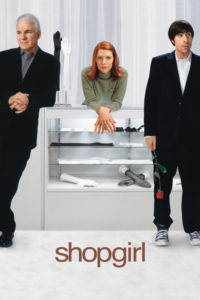
 Long before Claire Danes began earning multiple Emmy Awards as the bipolar Carrie Mathison on Showtime’s knock-out series Homeland, she starred in lesser-known independent movies like Brokedown Palace, Igby Goes Down, and 2005’s completely underappreciated Shopgirl. I watched this movie for the first time back in 2008 or 2009 and was blown away by how awesome and authentic it felt. This was long before Homeland. I have since watched every episode of Homeland (including seasons 1 and 2 twice each), so it was cool to re-watch Shopgirl, knowing everything that I know about the character she plays on the television show that earned her fame. Ironically, this was the first movie that Steve Martin (Parenthood, Three Amigos!) wrote. It turns out he’s written dozens of films (including Three Amigos!, Roxanne, LA Story, The Jerk, and Bowfinger), but this was his first non-comedy. The difference was that with Shopgirl, he wrote the novel in addition to the screenplay. And let me say that he did a great job. I had a couple of problems (which I will include below), but for the most part, he killed it. I would not read this review unless you’ve seen this movie. It’s going to be chock-full of spoilers. I would love to hear your thoughts on it if you have had a chance to see it. If you haven’t, you can just stop reading now and check out the movie.
Does this movie reinforce the point that the good guys can win? Possibly. Though Mirabelle (Danes) is the star here, the film would not work without the contrasting performances of Ray Porter (Martin) and Jeremy (Jason Schwartzman – Saving Mr. Banks, The Darjeeling Limited). I will use the actors’ actual ages at the time this movie came out, which will serve as a reference for a good chunk of this review. In 2005, Steve Martin was 60, Jason Schwartzman was 25, and Claire Danes was also 25. All three people are good-looking so that we can remove the attractiveness filter. In this movie, Jeremy and Ray are vying for the affection of Mirabelle. However, neither man knows the other exists. I don’t believe the two characters meet during the film. They are in the same scene briefly near the conclusion of the movie. Jeremy is a free-spirited oddball. He isn’t afraid to say precisely what he is thinking at any given moment (ironically, Ray isn’t afraid to say what he is feeling at any moment either, though this is where their similarities end).
Mirabelle works at Saks Fifth Avenue in Beverly Hills, California. She works the glove counter at the upper echelon department store, often catering to the rich and famous. From the moment we meet her, we can tell she doesn’t find satisfaction in her job. We don’t get much backstory from her, aside from learning that her real passion is art. However, she can complete a work of art only about once every six months. She dismisses the question of why she doesn’t complete projects more often. We don’t know her relationship history either. We know she is 25 and single at the start of the movie. At least a couple of her co-workers are a little more superficial in their work, whereas it is just a job to Mirabelle. It is how she pays her bills. She has no real passion for it. In fact, she doesn’t appear to have much of a passion for life. The way her life displays itself in the first few minutes of the film is mundane.
Mirabelle gets pursued first by Jeremy. They meet at a laundromat. He makes his interest in her well-known, whereas if he hadn’t approached her, she might not have acknowledged his presence. He has greasy, wild hair that falls wherever it wants. He wears disheveled clothes. Think of the word “grunge,” and you might think of Pearl Jam or Nirvana or, in particular, Eddie Vedder or Kurt Cobain. Imagine a penniless Eddie Vedder, and you have Jeremy. And by I mean poor, I mean broke, as he literally has no money to his name. He’s also quite quirky.
Some women would find it charming, while others would find it immature. Mirabelle seems to see a little of both. She likes his sense of humor and his straightforward nature, and his inability to accept her rejections slowly wins her over. Like Mirabelle, Jeremy is an artist. His main plan to become famous is to put his art on amplifiers you see at concerts. He believes the bland amplifiers used by all musicians are a missed opportunity and is determined to capitalize on it. Like he knows he will succeed with his plan to get famous via this career opportunity, Jeremy also thinks he will succeed with Mirabelle. He needs to bide his time. And sure enough, a couple of days later, she calls him, and they find themselves together in her apartment. The man is not smooth, and he would not have much of a chance with Mirabelle. Mirabelle is far from perfect, but she is certainly more mature than Jeremy. Nonetheless, despite some awkwardness and some social miscues, they spend the night together, which is good for both of them. They are both happy but insecure and still learning the book of love.

Enter Ray Porter, a man 35 years older than Mirabelle, who has so much money that he doesn’t know what to do with it. In just a couple of weeks, he has charmed the socks off Mirabelle so much that she completely forgets about Jeremy and then politely tells him that she has met someone else. Jeremy leaves Mirabelle and Ray throughout their entire relationship. He’s landed a gig (paid or unpaid, we aren’t sure), touring with a band. It’s hard not to consider at least that Ray is old enough to be Mirabelle’s father (really, grandfather, if you want to get nitpicky). Mirabelle is a beautiful woman who you think would have a line of suitors. But this businessman can enamor many women with his wit, natural good looks, and wealth. He is kind. He is generous. He is sophisticated. And he sweeps Mirabelle off her feet. He tries to explain that he is not looking for anything serious with her, but their signals get crossed, and what he hopes she heard and what she thinks she heard are two different things, which soon becomes a sticking point. She hopes to fall in love and start a family with this great man, while he is willing to stay committed to her until the relationship runs its course, and then the two can split amicably. But we know that neither of these things will happen.
Some parts of Shopgirl weren’t perfect. However, I will give the novel the benefit of the doubt. I’m going to assume these issues weren’t fully addressed in the movie because they had to fit within two hours. The first is Mirabelle’s use of antidepressant medication. This is a massive part of her character, but it isn’t addressed early enough. And when we first become aware of it, more than half the audience would have missed it. There is a scene where she goes back to her kitchen to grab a bottle of prescription medication, only to give it a quizzical look and a smile that only we, as the audience, can see before leaving the bottle. The movie shows that she will stop taking her medication because she feels happy. Some of us will “get it,” and it will make perfect sense. But most won’t. Most will wonder for a while what sort of medication it even was. I was trying to recall my first viewing of the movie to see if I remembered that was what she was doing, but I cannot recall.
In any case, we can see that Mirabelle is at her best when she is around Ray, but she feels anxious and worried when he is not around, trying to make sense of their relationship. They want different things, which does not sit well with her, to the point where she needs Ray to check her into a hospital when she’s having a difficult time. Steve Martin is not making light of the subject. In fact, he’s doing quite the opposite. It’s brought to the forefront. However, we moved past it before we dealt with it, as other parts of the story needed to be told, and there were only so many minutes to tell the entire story. I do understand that. I would rather have seen this movie made as it was than not have the film made. And I may read the book to see if the aspect of Mirabelle’s mental illness is discussed more in-depth. Ironically, her role as Carrie Mathison in Homeland has a disorder similar to Mirabelle’s, though she handles it differently. Perhaps, when casting for Homeland, the producers heard something in Shopgirl that convinced them that Claire Danes would be perfect for the lead.
The other, more significant problem I had with the movie was when Ray told Mirabelle he had cheated on her. He writes a letter and sits there unemotionally as she reads it, weeping. I don’t condone cheating at all. I give the character (and all cheaters) slight credit for informing the other person that they cheated, especially when, as would have been the case with Shopgirl, they clearly could have gotten away with it. Ray says he wrote the letter outlining what he had done because he wasn’t sure he could have gone through with telling her. But it was just awkward that she read the letter, crying her eyes out, while he sat on the edge of her bed. The way she reacted to the news, and what we knew about her character leading up to this point, would have suggested he would be out of her life forever right then and there. When cheated on, most of us lose the ability ever to trust that person again. I know many people can forgive and move past it. That would be something much easier said than done. I never understood that when I was younger. As I’ve gotten older, I’ve tried to understand, but I still look at the issue the same way. It may be different the deeper you are into a relationship, or if you have kids or whatever. But at the root of it lies the same issue. How do you ever trust that person ever again? I think saying “It will never happen again” is more misleading than saying “I will work hard at making sure this never happens again.”
It would have been perfectly acceptable for the movie to move towards its conclusion from that point. It could have ended nearly the same way as if she had decided to give Ray another chance. Life is messy, and I appreciate the uncertainty surrounding the relationships portrayed on screen. So while it was hard for me to believe that Mirabelle would have forgiven him, I realize that we are all different, and even if she had not forgiven him, other factors can come into play. Mirabelle loved Ray. And while she was significantly hurt and wanted to move on, her love for him and the belief that they could be something more ultimately won out in the short term, and she gave him another chance. But though she believes he won’t cheat on her again, she is still hurt because he doesn’t love her the same way that she loves him. While she is more than a convenience to him, she is not what she wants to be to him and knows she never will be. This ultimate acceptance (she had realized it long before) convinces her to end things. The line “So I can either hurt now or hurt later” is a fabulous line.
The ending of Shopgirl was fabulous. Jeremy returns enlightened. A little self-help and the ability to view life through a different lens allow him to woo Mirabelle differently. He still has quirky charm, but he has the skills to be an adult and be in an adult relationship. Mirabelle has found balance in her life, too. She can more effectively balance her job, relationships, and hobbies. One of the last scenes shows her hosting an art show with three other people. Jeremy is there. Ray shows up to offer his support, and this is the only time that Ray and Jeremy are in the same room.
Mirabelle says she will talk to her friend, and Jeremy is comfortable saying okay. Ray does bring a woman to this event, which is itself a question. Should he have done so? What if Mirabelle were not with Jeremy? Would Mirabelle be jealous? Did she deserve to be put in a position where she could have been made to feel jealous on her big night? The woman with Ray was closer to him in age, but that didn’t matter. She was still attractive. Did he bring her to be supportive? Or did he bring her to let both of them know that there was no chance that his being there was anything more than as a friend who wanted to support a person who meant so much to him? Lots of questions that don’t need answers here.

The very, very end was also fantastic. Ray said he didn’t want a committed, long-lasting relationship and that he had the upper hand with Mirabelle because he could end the relationship at any time without being hurt. In contrast, he hoped she would be able to do the same, but deep down knew that the end of the relationship could crush her. I never felt that Ray wanted Mirabelle to be hurt, but he knew he could never be. But as he watches her and Jeremy at the end, he sees two people, both 20 years his junior, in love. All he can do is wonder what he has lost with Mirabelle and what he might be missing if he could throw himself into an honest, loving relationship, one that involves real risks, and give it his all. The fade-out of Steve Martin’s character tells the story of so many of us who have never experienced true love, whether by choice or not, as we watch two people (whether we know them or not) truly in love with one another. It can be a crippling feeling. It can also be a feeling that we can prepare for, yet still be crushed by. Or we can look on, just like Ray does here, and wonder, “What if?”
The acting in this movie was fabulous. Martin plays Ray Porter perfectly. On the outside, he is confident, charming, financially secure, and seemingly able to get whatever he wants. He has absolute confidence that doesn’t even touch the cockiness many men would love to have. But this is perhaps the most vulnerable and inwardly insecure character that Martin has ever played. Parenthood is Steve Martin at his absolute best. Some will swear that movies like Dirty Rotten Scoundrels, Planes, Trains, and Automobiles, Roxanne, The Pink Panther, or The Jerk are the quintessential Steve Martin-defining movies. But that is the goofy Martin, and while that Martin is good and will make you laugh for sure, this shows Martin’s range as an actor. Unfortunately, he is not funny in this movie. Outside of his physical features, he is nearly unidentifiable. Schwartzman is the comic relief.
Martin is charming and likable, but humor is not one of the first ten adjectives you would associate with Ray Porter. And I was grateful for that. I LOVED seeing Martin outside of the goofy humor. We’ve never seen him in a role like this before, and if you are a fan of his work, you have to check out Shopgirl. The internal struggle you see him going through, just from his nonverbal cues, as he figures out his relationship and feelings towards Mirabelle, is reason enough to watch this movie on its own. But that is certainly not the only reason. Shopgirl is movie storytelling at its very best. And even when it isn’t perfect, there is enough around it to compensate for that fact. That is when you know you have something exceptional. And, for me, that’s what Shopgirl was, a remarkable movie that hit home with me in many ways.
Plot 9/10
Character Development 8.5/10
Character Chemistry 9.5/10
Acting 9.5/10
Screenplay 8.5/10
Directing 8.5/10
Cinematography 9/10
Sound 9/10
Hook and Reel 9/10
Universal Relevance 9.5/10
90%
A-
Movies You Might Like If You Liked This Movie
- Celeste and Jesse Forever
- The Good Girl
- Me Before You
- Mr. Jones
- Meet Joe Black