 Occasionally, poorly received biopics are victims of having all the necessary elements in place, except for a compelling story. One notable example is the 2009 film Invictus. Filmgoers had been clamoring for a biopic about Nelson Mandela. When Clint Eastwood signed on to direct a movie starring Morgan Freeman as Mandela, it seemed like a lock that the film would be, at the very least, a best picture candidate. Eastwood, with three Best Director Oscar nominations (Mystic River, Letters from Iwo Jima, Million Dollar Baby) over the previous half dozen years, was at the peak of his behind-the-camera career. Freeman, also at the height of his career, had been just about everybody’s favorite choice to play the South African anti-apartheid activist turned politician, whenever the right opportunity arose. And yet, we ended up with a movie that revolved around a rugby team attempting to qualify for the 1995 World Championship. Invictus wasn’t a bad movie. By many accounts, the film was a success. It earned positive scores with critics (75% fresh on Rotten Tomatoes, 7.3 on IMDB, 7.4 on Metacritic). While it failed to break even domestically (with just $38 million in revenue from a $60 million budget), it earned an additional $85 million internationally. While Freeman did earn an Oscar nomination for his portrayal, many of us wonder what could have been had the film centered on a more compelling story.
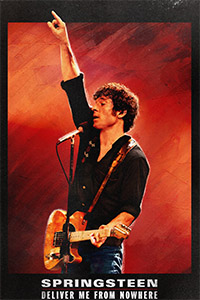
The same could be said of Scott Cooper’s (Hostiles, Out of the Furnace) Springsteen: Deliver Me from Nowhere, the 2025 Bruce Springsteen biopic. The film could have touched on a variety of aspects of Springsteen’s life. It chose to center on the time around his writing of his quiet, retrospective Nebraska album.
In 1982, with smash radio hits from his first albums, such as “Born to Run,“ “Thunder Road,“ “Prove It All Night,“ “Badlands,“ and “Hungry Heart,” Springsteen was on the edge of superstardom. Springsteen’s label and fans were ready, clamoring for his next album, eager to ride that wave. However, this wasn’t something that Bruce wanted to do. It was a period in his life when he tried to shift away from the rock hits for something quieter. With megastardom a sure thing, Springsteen wondered if he was ready for it, or if it was something he even wanted. He was at a ‘no turning back’ crossroads in his life. Despite the resistance, he wrote the soft and gentle Nebraska, an album that would become a huge bestseller, but was met with much trepidation from the studio and his team at the time.
Jeremy Allen White (The Iron Claw, After Everything) stars as Springsteen. He’s the right actor for the role, but it wasn’t a memorable performance. All of the Oscar buzz surrounding the performance before it had even been screened should have been tabled. Unlike Rami Malek (Bohemian Rhapsody), Jamie Foxx (Ray), Joaquin Phoenix (Walk the Line), Austin Butler (Elvis), or, most recently, Timothée Chalamet (A Complete Unknown), White doesn’t disappear into this role. Each of these actors was nominated for a Best Actor Academy Award, with Foxx and Malek each taking home the prize. However, White’s lackluster performance wasn’t just on him. The film lacked substance. The story was boring. It was a quieter film. It didn’t have the numerous performances you might expect. It was a quieter film. The problem was that it was too quiet. If you weren’t careful, it could have put you to sleep.
Jeremy Strong (The Apprentice, Armageddon Time) gives the film’s best performance as Jon Landau, Springsteen’s manager and producer. He does a fantastic job of examining Springsteen as an artist who can make him and many other people money, but also as a human being, going through the full range of human emotions. Springsteen employs him, but he’s also his friend. He does an incredible job of balancing this, struggling (somewhat) with what is best for him and what is best for his friend. He’s a likable supporting character, and the type of person that all of us would like to have in our lives. While White and Strong were good enough individually, the connection between these two acting powerhouses was missing. It felt, at times, that they were in two completely different stories.

There will be times during your viewing when you may ask yourself, “Why am I watching this movie? This movie isn’t teaching me anything I didn’t already know or that I don’t care to know.” The film doesn’t provide a reason to care or justify its existence. If it weren’t Bruce Springsteen, this would be a nothing story that moviegoers would consider to be a waste of their time. Boring. Didn’t offer anything that other music biopics didn’t have. Coming a year after the purposeful and enjoyable A Complete Unknown, Springsteen: Deliver Me From Nowhere felt like even more of a letdown. A Complete Unknown had flow. It had singing. It had recognizable songs. It had continuity. It had transformative performances with Chalamet. It had time and place uniformity. It had character relationships that we cared about. The Springsteen movie didn’t have any of these. It felt too familiar. It lacked narrative drive. Its overpacked screenplay didn’t allow the film to breathe. Whenever we started becoming invested in a particular part of the story, Cooper hastily shifted us away.
For those who have read Springsteen’s autobiography “Born to Run,” some of the additions and omissions will be noticeable. While the book encompassed much more than just the “Nebraska” writing sessions, it seemed like Cooper honed in on the often distant, sometimes tense relationship between Bruce and his father, masquerading as an undiagnosed mental condition. When reading the book, I didn’t find this relationship to be nearly as intense as the film portrayed it to be.
Another glaring difference between the actual story and the movie was the addition of superfan Faye Romano (Odessa Young – The Order, The Damned), a local diner waitress and young mother. Bruce did not have a steady, romantic love interest during this period of his life. Faye was a fictional composite love interest used to humanize Springsteen. Faye is highly supportive, but also frustrated by Bruce, who showers her with affection one minute, only to push her away the next, preferring to withdraw into his writing as a means to navigate his conflicts and struggles. Many will argue that this fictitious relationship compromised realism, introducing sentimentality in place of truth, which may be particularly troubling for a film that aims to center itself around authenticity.

The shift in the biopic in recent years (particularly when it comes to musicians) is to focus only on a specific portion of a person’s life, rather than that person’s entire life. It’s something that I’ve grown to appreciate. However, it’s something you want to know before a viewing, whether it’s all-encompassing or segmented, as there might be a letdown if you’re expecting one story but get another. Springsteen: Deliver Me from Nowhere is a very finite story from the rock star’s legendary career.
Springsteen: Deliver Me from Nowhere is too close to your typical run-of-the-mill musical biopic to stand out. More often than not, I would place it in this category. While it didn’t do anything poorly, it didn’t do anything great. It was a meh. Given Springsteen’s extraordinary career, I didn’t think this particular story needed to be told. What we are left with is a couple of terrific performances in an otherwise hastily told, rushed, and unmemorable biopic.
Plot 6/10
Character Development 8/10
Character Chemistry 8.5/10
Acting 9/10
Screenplay 7.25/10
Directing 7/10
Cinematography 8.5/10
Sound 10/10
Hook and Reel 7.5/10
Universal Relevance 8/10
79.75%
C+
Movies You Might Like If You Liked This Movie