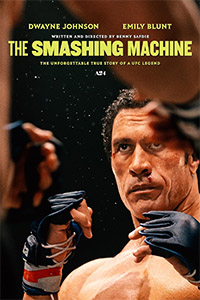
 You’ll remember it for the acting. Dwayne Johnson (San Andreas, Fighting With My Family) and Emily Blunt (Sicario, A Quiet Place) deliver a pair of Oscar-worthy performances in Benny Safdie’s (Good Time, Uncut Gems) raw and unapologetic The Smashing Machine. Based on the true story of Mark Kerr, a mixed martial arts (MMA) fighter who entered the international Ultimate Fighting Championship (UFC) circuit in the late 1990s, The Smashing Machine chronicles Kerr’s first professional fight, his early success in Japan, his personal struggles with opioid addiction, and the ups and downs of a volcanic, often toxic relationship with his girlfriend, Dawn (Blunt).
The Smashing Machine is a story that, in itself, didn’t require a full feature film. The story doesn’t stand out from the thousands of other movies that say something just as, if not more, profound. Safdie works with a plot that, at its best, gives a “been there, done that” type of feel, and, at its worst, leaves the audience thinking, “Eh.” The meteoric rise to success and the subsequent collapse won’t be the lasting impression. It is watching Johnson and Blunt each deliver the best performances of their careers. Each actor disappears into their role, physically and emotionally.
Let’s start with Johnson, as he’s the film’s main protagonist. While it’s easy to imagine Johnson as a superhero or in an action or comedy role, watching him in a more serious one could be difficult for some. Couple that with his persona as the WWE character The Rock, and it’s fair to wonder if he could pull off playing a real-life wrestler who draws nearly no comparison to the one he portrays. He crushes it. His portrayal of Mark starts with a kind and gentle man, striking up a conversation in one of the film’s first scenes with an older woman in the clinic waiting room, and then giving her elementary school-aged grandson an autograph. He finds success in MMA in Japan, accumulating wins without a single defeat. Disguised with heavy make-up, some who know nothing about the film might, and are watching the trailer for the first time, might wonder who the actor is they are seeing.

As good as Johnson was, Blunt was better. While each could earn Oscar nominations, Blunt has the better chance. While critics might say that she portrayed her character in an overly exaggerated manner, failing to distance herself from the stereotypical girlfriend in other boxer/fighter movies, I felt she brought a side to Dawn, in which she loved and supported her partner, but felt, not only forced to hide her authentic self, but that she was constantly walking on eggshells around Mark. At times, Mark would speak to Dawn condescendingly. She’d compliment him, only for him to turn it around into something unintended. As much as we rooted for Mark, a glimpse of him through Dawn’s eyes caused us to reexamine whether we were cheering for the right person. For those needing an introduction to what gaslighting actually looks like, The Smashing Machine provides a great example. Blunt shows us what it feels like to be in a relationship that isn’t built on, nor will ever reach, equal footing. The relationship often felt like a chore to Mark. Blunt encapsulates that.
For as good as Johnson and Blunt were individually, their onscreen chemistry defined the film, but also reminded the audience that these two actors are still in entirely different leagues. Johnson’s transformation is what most will remember. Johnson is a huge draw. With more than 25 movies surpassing $100 million, he’s a financial windfall. While some performances are better than others, filmgoers don’t turn out to see Johnson’s films hoping for great acting. They are looking to be entertained. Film junkies will quickly see that Blunt is the star of this The Smashing Machine. What could have been a wasted performance by one of our most talented working actors, serving as background fodder in a way that makes Mark appear more the sympathetic hero, whether at the expense of the other characters or not, didn’t fall into that cliche. The complete opposite happens. Dawn brings a humaneness to her role. She isn’t the supportive girlfriend. She isn’t the crazy one who can’t deal with Mark’s success and is responsible for his downfall. She paints a picture of profound disappointment, loss, and regret with her nonverbal actions alone.

The cinematography is excellent. Safdie doesn’t go into the details of Mark’s conditioning, training, or nutrition, or his matches. It isn’t vital. Unlike a lot of fighting movies, we aren’t in the ring much with the combatants. Mostly, we are viewing the match as if we were front-row spectators. When we are in the ring, it is with a shaky handheld camera, which feels far different from the point of view we’ve grown accustomed to in films like Creed, Warrior, Bleed for This, Southpaw, and many others. This is purposeful and brings forward the character’s emotions as the center of attention, rather than the matches themselves. The fighting was unspectacular and brief, both by design. It doesn’t detract from the film, but some will be disappointed if they are unaware and are expecting it. Each time we expect the film to follow a familiar trope, Safdie takes us in a direction that is unique and unfamiliar. The opponents become indistinguishable. The matches end as quickly as they begin. From start to finish, the reward of The Smashing Machine is the impact the acting leaves on its viewers.
Unfortunately, I found one major issue with the film. We never see the spiral of opioid addiction. We are told of it instead. We do see Mark work the healthcare system, smooth-talking his way to more of the drug, at higher doses, and in routes of administration that most easily achieve his desired result. We receive a brief clip of a singular event that lands him in rehab. It falls flat. We don’t see any of his time in rehab. While this was intentional, I don’t believe it was in the film’s best interest. Safdie, with each scene, draws us more into a character that we’ve become increasingly invested in. But then, in one of the film’s defining moments, he pulls us away, leaving us both searching for more while feeling disconnected when his addiction, for all intents and purposes, is defeated. Just like with recovery from any addiction, there will be seasons that are more difficult than others. Unfortunately, we don’t see them with this character. When he reemerges, Mark is clean and seemingly free of the temptations we might expect. It didn’t work for me. While I understand that Safdie might not have wanted to layer the depth Mark likely ventured into, I wanted to see it. I needed to see it. It brought the film from one I would have rewarded with an A to the A- tier. Missed opportunities to engage organically with a thirsty filmgoer deserve to be called out. It’s my one gripe with a film that has stayed on my mind ever since my first viewing concluded.
Plot 7/10
Character Development 9/10
Character Chemistry 9.75/10
Acting 9.5/10
Screenplay 7.75/10
Directing 8.75/10
Cinematography 10/10
Sound 10/10
Hook and Reel 10/10
Universal Relevance 10/10
91.75%
B+
Movies You Might Like If You Liked This Movie