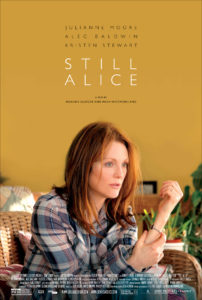
 Still Alice is a slightly above-average movie with the best lead performance you’ll see from an actress all year. There are only a couple of shoo-ins at this year’s Academy Awards. I believe that most categories are predictable, but there will be a couple of surprises. The big ones that will not come as a surprise are Patricia Arquette (Best Supporting Actress – Boyhood) and Julianne Moore for her performance as a 50-year-old woman suffering from Early-Onset Alzheimer’s Disease in Still Alice. Each year, there is a movie that earns a significant award but is not recognized in any other category. This year, that movie is Still Alice. I’m not a huge fan of Moore. I think she’s good, but she’s slightly overrated. Nonetheless, she is due to be recognized, and this is the lead performance that is head and shoulders above the other contenders.
It’s hard to recommend this movie based on anything other than Moore’s (The Hours, The End of the Affair) outstanding performance. The film feels like a movie you would see on Lifetime, but with big-time Hollywood actors. However, the performances are great, and the problems here feel real. There isn’t a lot of melodrama here, meaning they don’t insert drama just for the sake of drama. Though there was quite a bit of sniffling from the audience, I didn’t think anything was too overdone. It was just one person reacting to a life-altering diagnosis, and then the reactions of those people closest to hear as they try to deal with the situation themselves. We feel bad for Alice (Moore), but I wouldn’t say we ever feel sorry for her. Maybe we do. It’s hard to put into words what I would like to say. The disease is debilitating, and we see it at the onset and how it takes Alice on its terrible and unforgiving ride. It’s heartbreaking to watch. But she deals with it in a way that is both real and noble.
Alice is not perfect, but she did live a pretty ideal lifestyle before the diagnosis of her disease. She recently celebrated her 50th birthday with her family. She has a supportive and loving husband in John (Alec Baldwin – The Cooler, television’s 30 Rock). She has three great kids. Anna (Kate Bosworth – Straw Dogs, Blue Crush), her eldest, is a successful lawyer. She is married and trying to have children with her husband, Shane. It is assumed that most things have gone her way in her life. Tom (Hunter Parrish – It’s Complicated, television’s Weeds) is a middle child who seems to jump between relationships, although his heart appears to be in the right place. He has also been successful early in his career in the medical field. Then there is Lydia (Kristen Stewart – Twilight, Jumper), Alice’s youngest child, and the one whose life isn’t quite going as Alice had planned. Whereas her two older children live in New York, Lydia is a carefree actress, a little too easily agitated. She lives in Los Angeles while training to break into the acting business. There is friction between Anna and Lydia, as well as some tension between Alice and Lydia. Note the descriptions of her children here because they come into play as you watch this film.
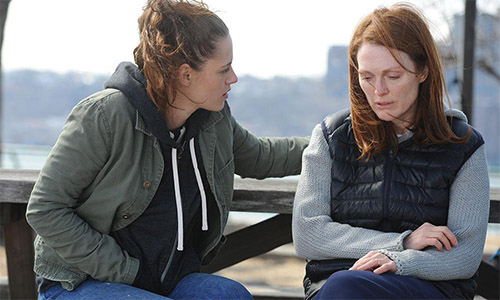
Aside from her beautiful family, Alice is a distinguished professor of linguistics at an esteemed university in New York. I’m not sure they ever see it, but I think we can assume it is either NYU or Columbia. She is so widely recognized that she is flown in to deliver speeches all over the country. She is as sophisticated, dignified, classy, intelligent, mature, and sexy as they come. However, she begins to recognize something is not right early in the film. During a speech, she forgets something she was about to say, but can play it off as drinking too much champagne before recomposing herself and giving the rest of the address flawlessly. However, the bouts of forgetting things begin to increase, and soon she consults a neurological doctor. It is there, after numerous tests, that she is diagnosed with Early Onset Alzheimer’s Disease. I’m not entirely sure about the time lapse of this movie from start to finish, but I think it spans about a year. During this period, we see her crumble from her ideal self to someone who cannot even recognize her own daughter.
It truly is heartbreaking to watch her mind fail her. Still, directors Richard Glatzer (The Last of Robin Hood, Quinceañera) and Wash Westmoreland (The Last of Robin Hood, Quinceañera) don’t intend for you to weep through these 90+ minutes. It would be easy to do since they had the formula and the talent. Instead, they chose to portray Alice as a highly determined person driven to live her life as she wants to live it for as long as she can. When a person is given a death sentence like Alice, the normal associated human emotions will present themselves. At times, she is also sad and angry and tries to use her disease with her family to get what she wants. However, she’s determined not to let the condition outlive her. She is meticulous about this by writing simple questions to herself that she answers daily. And she has a plan that when she can no longer answer these questions, she will commit suicide. It is methodical in how well she thought this out.
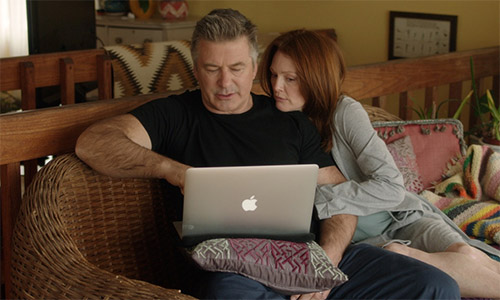
Baldwin was excellent as Alice’s husband. He loves his wife and is there to support her in every way he knows how. But even the world’s most perfect husband is not Superman. He begins to get angry that he cannot help fix the situation and save his wife from this disease that knows no limits. Likewise, he is conflicted about how to continue living his own life. Financially, he needs to work. Occupationally, he is doing very well in his career with growth opportunities. He struggles with balancing what’s best for him with what’s best for her and the family. Likewise, the three children all handle the situation differently. While all three are terrified, knowing their mother soon will not be who she was, they react differently (as we all would). The family dynamic was great. This is a close-knit family, but not a perfect one. It wasn’t ideal at the start of the movie, and it remains incomplete at the end.
But the real story here is Moore. In a few weeks, she will earn the award she has been working towards her entire life. She will receive the Academy Award for Best Actress in a Leading Role. She has four other nominations to date (two for Lead Actress and two for Supporting Actress). There is no way that Reese Witherspoon (Wild), Felicity Jones (The Theory of Everything), Rosamund Pike (Gone Girl), or Marion Cotillard (Two Days, One Night) will unseat her. That won’t happen. And it shouldn’t. Moore’s transformation from the character she was at the start of the film to the one she becomes by the end is terrific. She devastates our hearts, but does so in a way that does not make us sorry for her. Instead, she’s as strong as she can be until the disease ultimately takes her away. And before she does, she figures out what means most to her in this life and how she can ensure that she maximizes her happiness in the remaining time she can remember.
There have been many, many, many better movies on mental illness. Off the top of my head, I can think of the excellent Take Shelter (the onset of Schizophrenia in a man), Away From Her (Alzheimer’s), Silver Linings Playbook (Bipolar Disorder), A Beautiful Mind (Paranoid Schizophrenia), Shutter Island (Delusional Disorder), and The Hours (Major Mental Depression), to name a few. Each movie listed was better than Still Alice. While all of these movies featured fantastic lead performances, Moore’s performance at least rivaled those and, in some cases, surpassed them.
Plot 9/10
Character Development 9.5/10
Character Chemistry 9/10
Acting 10/10
Screenplay 7.5/10
Directing 8/10
Cinematography 8/10
Sound 6.5/10 (the music is soft and delicate…it works at first, but it does get annoying…and it’s a constant presence)
Hook and Reel 8/10
Universal Relevance 9/10
84.5%
B-
Movies You Might Like If You Liked This Movie
- Cake
- The Father
- What They Had
- You’re Not You
- Life As a House