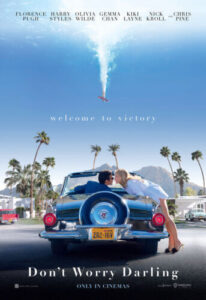
 Don’t Worry Darling, Olivia Wilde’s (Booksmart) may have been the most talked about movie of the year. While the film garnered much buzz, it was the much-publicized dysfunction between some cast members (most notably Wilde and Florence Pugh) and different versions of why Shia Labeouf exited from his role (he said/she said story from he and Wilde) and how it played out in the reputable news outlets, as well as the tabloids and social media. There was much worry that Wilde’s second directorial effort would be known for the hoopla around the film rather than the film itself. With a production budget of $35 million (compared to just $6 million for Booksmart), I’m sure Wilde felt considerable pressure for her film to succeed. Despite its lukewarm ratings among critics, 39% on Rotten Tomatoes, it has resonated with audiences (82%). While not a perfect movie, I was thoroughly engrossed in the setting, the characters, and where the story would lead.
Category Archives: Drama
True Things (2021)
 If you have the opportunity to watch or if you get the chance to watch the Ruth Wilson-led (Oslo, Showtime’s The Affair) True Things, pay particular attention to the film’s opening and closing scenes. There is considerable symbolism at the two ends, almost leveling us back even after going up and down several peaks and valleys in Harry Wootliff’s (Only You) heavy romantic drama.
Elvis (2022)
 Ray, it is not. Walk the Line, it is not. Straight Out of Compton, it is not. Bohemian Rhapsody it is not. Baz Luhrmann’s Elvis (Moulin Rouge, The Great Gatsby) is slightly better than the disappointing Rocketman. The highly-anticipated Austin Butler-led (Once Upon a Time… In Hollywood, The Bling Ring) biopic had lofty expectations, considering that it was the one that the Presley family agreed was the true reckoning of Elvis’s life and legacy. While engaging for its lengthy 159-minute run-time, the film often felt disjointed and needed direction. With its shifting narrative, viewers often wondered if this movie was about Elvis Presley or more about Colonel Tom Parker (Tom Hanks –Captain Phillips, Sully), his deceitful, longtime manager.
Three Colors: Blue (1993)
 Blue is the first in Polish-born Krzysztof Kieslowski’s (The Double Life of Veronique, No End) three-part trilogy, aptly named Red, White, and Blue. While showing very little connection and not intended to be watched in any particular order, Blue (1993) had a release date before White (1994) and Red (1994). Blue also features the most recognized actor (Juliette Binoche – The English Patient, Chocolat). So, either on its own was enough to start with Blue. Together, it was a no-brainer.
Breaking (2022)
 Abi Damaris Corbin’s quiet feature debut, Breaking, is a movie that does everything Nick Cassavetes’s disaster John Q failed to do when it managed to make $71 million domestically in 2002. Of all the things Denzel Washington has saved in his movies (subways, jets, submarines, locomotive trains), holding up a hospital and forcing a doctor to perform life-saving surgery on his son was, by far, his worst. Unfortunately, Washington’s always-solid performance couldn’t save an absurd script based on a ridiculous presence. The based-on-a-true-story Breaking offers breakout performances by Corbin and the film’s lead, John Boyega (Detroit, The Woman King), most notably recognized for his role as Finn in the latest Star Wars movies.