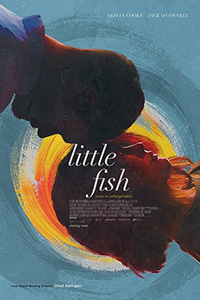
 Little Fish, the limited release and widely underseen 2020 film from Chad Hartigan (The Threesome, Morris From America), was a movie that captivated me so much that I turned it off 30 minutes in while falling asleep late at night, knowing I could not give the film the full justice it needed, and started it from the beginning the next morning. Released straight to streaming during the COVID-19 pandemic, most who have watched this film likely did so through word of mouth or because they are fans of one or both of the two lead characters, each an A-list actor with a large following.
Emma (Olivia Cooke – Life Itself, Sound of Metal) and Jude (Jack O’Connell – Sinners, Jungleland) star as star-crossed lovers who meet during a global pandemic in which humans are afflicted by an illness that targets their memory, causing them to forget both long-term and short-term details, as they attempt to sustain their relationship during the infancy of one of the two actors’ illnesses.
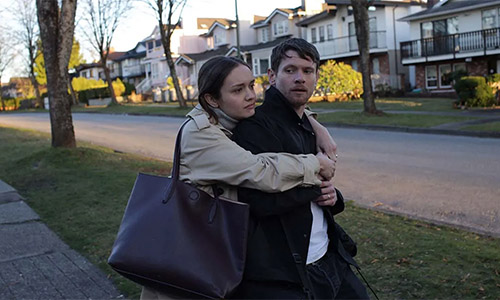
Neuro-Inflammatory Affliction (NIA) is the name of the memory loss illness, and it can claim its victims in one of two ways. The first way is a ‘slow drip,’ where people lose pieces of a memory at a time. The other way is a ‘sudden snap,’ where people forget large amounts of memories all at once. Secondly, we learn that NIA affects people in two ways: as a slow ‘drip’ of memories, where people lose fragments at a time, or as a sudden ‘snap,’ where people forget huge amounts all of a sudden. This ugly, unpredictable plague can strike anyone, young or old. At the start of our story, it has already cripled a large part of the world’s population. Love in the time of a global pandemic.
The film is told in a non-linear fashion, mostly in the present day, with Emma and Jude happily married, though flashbacks go back to the day they first met and fell in love, as well as in the early and later stages of the disease. In between are moments that sequences begin and end, though we are purposely left to connect some of the dots.
Little Fish had a lot going for it. It had characters whom you rooted for. We like Emma. We like Jude. We want the best for each. We know early on that this will never happen. Success also lay in its fragmented timeline, which was not necessarily meant to confuse us but to prompt us to craft our own theories about Hartigan’s film. The film contains a lot of misdirection, with sequences and flashbacks that deliberately blur the chronology, causing us to wonder if what we see is real or if it’s seen through the eyes of an unreliable narrator, and whether that narrator is Emma, Jude, both, or neither. The ambiguity of its science-fiction element, combined with the clarity and believability of their romantic connection, kept me fixated, even as I knew I was likely in for a devastating conclusion.
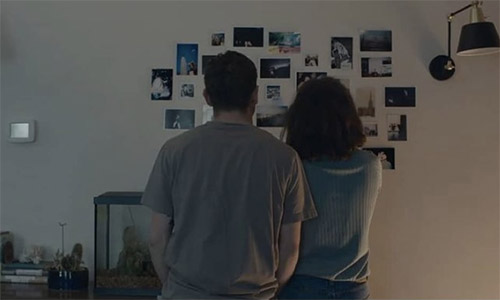
Little Fish was a little treat. I am grateful for whatever reason compelled me to switch to my Sundance instead of the usual Hulu or Netflix on a random Friday night. I needed my fix for a heavy sci-fi romance, and I got my fill with Hartigan’s gripping, thought-provoking, and understated film.
Plot 8/10
Character Development 8.5/10
Character Chemistry 8/10
Acting 10/10
Screenplay 8/10
Directing 8/10
Cinematography 7.75/10
Sound 9.75/10
Hook and Reel 9/10
Universal Relevance 9/10
86.5%
B+
Movies You Might Like If You Liked This Movie
- Eternal Sunshine of the Spotless Mind
- About Time
- The Time Traveler’s Wife
- Frequency
- Blue Valentine