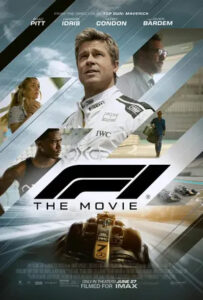
 If after watching the trailer for F1: The Movie, whether it be be at the theater, on a streaming service, or while you’re watching YouTube and you say to yourself, “That movie looks like it’s the Top Gun movie, but on a racetrack,” you wouldn’t be far off in your assessment. If you combine that feeling with other racecar or other inspirational sports movies, you’ll have the formula that makes F1: The Movie. Joseph Kosinski (Only the Brave, Oblivion) directed Top Gun: Maverick, so drawing similarities between the two films isn’t a stretch. Top Gun: Maverick was my favorite movie of 2022. It was a masterclass in storytelling, as well as what you could do with a production budget of $170+ million. That’s what makes it such a shame that F1: The Movie, with a budget exceeding $250 million, felt like nothing more than a retelling of better racing movies, which had smaller budgets, were more original, and offered stories and characters that we genuinely cared about. F1: The Movie felt like a propaganda movie to entice viewers to follow Formula 1 racing.
For Love Of The Game (1999)
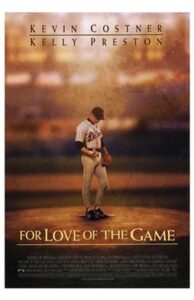 I first watched Sam Raimi’s (Spider-Man 2, A Simple Plan) For Love of the Game in the fall of 1999. It was the day after Virginia Tech defeated Clemson at Lane Stadium on ESPN’s Thursday Night Football. My dad had come down for the game. The day after, we went to see the Kevin Costner-led (A Perfect World, Field of Dreams) baseball drama. I’m a sucker for films that seamlessly incorporate flashbacks to advance the story better. For Love of the Game did just that, perhaps, at the time, in a way that I hadn’t seen before. 23-year-old me left my viewing thinking that it was one of the top 10-15 movies I’ve ever seen.
28 Years Later (2025)
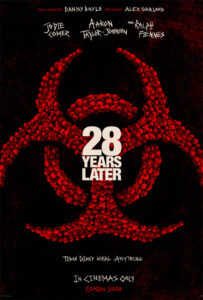 When director Danny Boyle (Slumdog Millionaire, 127 Hours) and screenwriter Alex Garland (Ex Machina, Civil War) teamed up for the 2002 film 28 Days Later, little did we know what a cultural phenomenon this under-the-radar, “Zombie if they were infected with Rabies” story filmed on an $8 million budget would become. Nor did we know just how well Boyle and Garland would complement each other, as director and screenwriter, respectively. Having become a timeless film that ignited a quarter century of zombie fiction movies, television shows, books, and video games, 28 Days Later modernized this horror sub-genre with its “what if the infected zombies moved at warped speed rather than at a snail’s pace” question.
28 Weeks Later (2007)
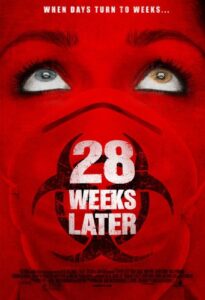 28 Weeks Later, the sequel to the box office success and critically acclaimed 28 Days Later (2002), directed by Juan Carlos Fresnadillo (Intruders), seemed like it was destined for failure before it even began. With the relative newcomer replacing the seasoned Danny Boyle in the director’s chair and without the help of screenwriter Alex Garland, 28 Weeks Later could have easily been looked at as a cash grab, looking to earn a quick buck off of name association alone, while coming at the expense of a lesser story or one that was poorly executed. However, that was far from the case. While not as crisp or innovative as the original, 28 Weeks Later quickly established itself within the franchise, while also becoming a standalone film in its own right. Continue reading 28 Weeks Later (2007)
28 Days Later (2002)
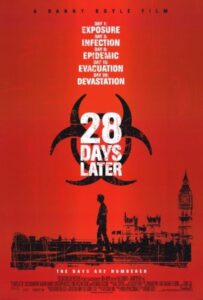 The moviegoer is in for a treat each time when either Danny Boyle or Alex Garland is involved in a project. Whether it be Boyle with a timeless filmography of directing credits that include Sunshine, Trainspotting, Slumdog Millionaire, and 127 Hours, or Garland’s vision with outside-the-box, ahead-of-his-time instant classics, such as Annihilation, Ex Machina, or Civil War, you can be confident you will be thinking of the film long after its view. 28 Days Later was the first time the two teamed up (Boyle as director, Garland as screenwriter). They struck a perfect accord of a tense, suspenseful, and foreboding film, painting a grim picture of what humanity could look like under the direst of circumstances.