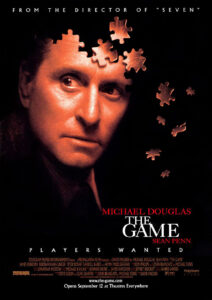
 1997’s The Game was David Fincher’s first directorial effort, following the highly successful, fan-favorite Se7en. Fincher’s first movie was Alien 3, which had many franchise fans wishing the series had ended with Aliens. With one flop and one success under his belt, Fincher needed to make a statement with his third movie to prove that Se7en was not a fluke. The Game grossed $48 million at the box office, roughly half of what Se7en brought in, but this was still considered a success. Moreover, perhaps more importantly, it was a success with the critics. Following this movie, Fincher became a household name. Still, he has carefully selected his projects. From 1993 to 2010, Fincher directed just nine movies. However, His most recent films (The Social Network, 2010, and The Curious Case of Benjamin Button, 2008) garnered him Academy Award nominations for Best Director.
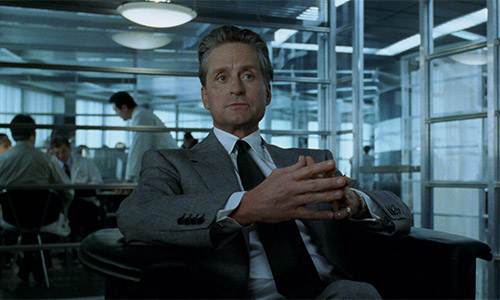
Michael Douglas (Wall Street, Fatal Attraction) is Nicholas Van Orton, a ruthless and compulsive multi-millionaire investment banker who treats the people in his life like commodities he buys and sells on a stock exchange. We see early on that his interactions are with people lower in status, with less power, and in lower positions. These interactions make us very much less like Nicholas in the early going. Nicholas is also dealing with his 48th birthday, turning the same age his father was when he committed suicide right before Nicholas’s eyes. Nicholas has recently been having recurring nightmares of that day. Despite his wealth and his power, Nicholas leads a very lonely life. His only day-to-day interaction with anyone outside of the office is with his housekeeper, who lives in a small house on his mansion property. He rarely talks to his only brother or his mother.
When he meets his brother, Conrad, played by Sean Penn (Milk, Mystic River), he is convinced to participate in a game that “saved Conrad’s life.” Despite his initial reservations and unwillingness to relinquish control over any aspect of his life, Nicholas promises Conrad that he will try. He will call the number on the business card he receives and give the game a chance, because he sees how Conrad has changed for the better.
Once Nicholas agrees to give “the game” a chance, we watch as he loses this control, slowly at first, before spiraling into a world that he no longer recognizes, let alone commands. Now, while some situations and scenarios seem very far-fetched, if you can take them for what they are worth and admire and appreciate Douglas’s range as an actor in this movie, you’ll leave feeling rewarded. If you try to overanalyze with “That seems a little far-fetched” or “There are far too many coincidences going on here,” you will probably leave feeling disappointed.
The most rewarding part of this movie is watching Nicholas’s change. When we first meet him, he is a person who has complete control over everything in his life. His callousness in the first 20 minutes sets the tone for the rest of the movie. His connections with the world end at the end of each workday, as he prefers to dine at home alone while watching business reports on CNN.
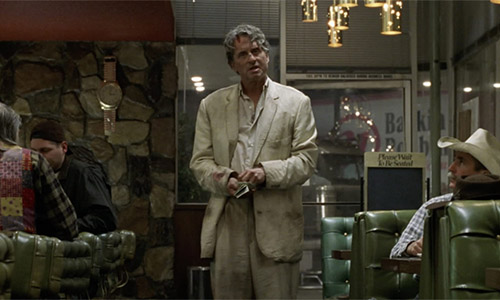
While some of the sequences in the movie range from unlikely to completely implausible, if you allow yourself to go along for the ride, you will enjoy seeing the destruction of a character. Nicholas seemed to have meticulous control over virtually every aspect of his life and the measures he took to make amends for his mistakes along the way.
Plot 9/10
Character Development 8.5/10
Character Chemistry 8.5/10
Acting 9.5/10
Screenplay 9.5/10
Directing 9/10
Cinematography 9/10
Sound 9/10
Hook and Reel 9/10
Universal Relevance 9/10
90%
A
Movies You Might Like If You Liked This Movie
- Vanilla Sky
- Shutter Island
- Identity
- Flightplan
- Gone Girl