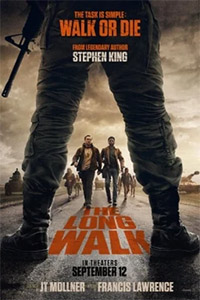
 Sometimes it’s tough not to recommend a good movie. While there are exceptions to the rule, they are rare. Francis Lawrence’s (Red Sparrow, The Hunger Games: Mockingjay, Part 1) adaptation of Stephen King’s 1966 novel The Long Walk is one of those. I imagine his book wasn’t overly controversial when it was published, particularly given that media, such as novels, didn’t have the same reach they do now. Likewise, Stephen King was still a relative unknown. In fact, he wrote this novel under the pseudonym Richard Bachman. That is all to say that a work of fiction that dealt with something as dire as this story’s plot likely wouldn’t have seen the light of day. Nonetheless, once King earned the “King of Horror” nickname, his bloodthirsty fans would undoubtedly search for and find his earlier works.
Like so many of his novels, The Long Walk is set in the last quarter of the century in a New England town. Specifically, this film takes place in 1970s Maine. The plot centers on a devastating war that has ravaged the United States, leaving the nation in nationwide despair. To promote a sense of unity, the President has created a game of survival in which one 18-year-old boy from each state volunteers to compete in the long walk. In this endurance contest, each boy must walk down an endless country highway at a minimum speed of 3 mph. If a contestant loses speed, they get a warning and ten seconds to regain their footing. After a third warning (contestants get three warnings per hour), they are shot dead. Yes, a bullet to the head and viewable for all audience members to see in graphic detail.
The film’s premise is very dark, as is its delivery and execution. I was somewhat surprised that the project got greenlit and then had a release date in the USA when it did, given its timing in the wake of tragedies around gun violence. A decade ago, The Long Walk might not have been made, let alone given a theatrical run. Two decades ago, it likely wouldn’t have been.

Lawrence, who also directed the 2nd-4th films of The Hunger Games franchise, does a great job of bringing his characters to life. It would have been impossible to introduce us to all 50 boys, while limiting us to just two or three characters would have taken away much of the drama and intrigue. Lawrence allows us access to about 15, with more story fleshing of 6-7. In a film that runs at 108 minutes and features this many characters, each boy’s introduction must be quick and memorable. Lawrence achieved those, though it came at the expense of narrative limitations and a lack of story flow. We never learn which boy is from which state, nor is there any association between boy and state, implied or inferred. 50 states. 50 boys. One from each state. But no association with character and state. The characters’ backstories aren’t fully developed. Perhaps this was by choice. Maybe this was due to time constraints. It’s noticeable, but understandable. From a suspense perspective, this works.
Ray (Cooper Hoffman – Saturday Night, Licorice Pizza) and Peter (David Jonsson – Alien: Romulus, Rye Lane) are the characters we spend most of our time with. This generally means that these two will either get along well or clash. Ray is intelligent, thoughtful, and sensitive. Peter is vibrant, inspirational, and optimistic. The supporting characters include foul-mouthed Hank (Ben Wang – Karate Kid: Weapons, Sight), the formidable Stebbins (Garrett Wareing – The Return, All the Money in the World), restrained Collie (Joshua Odjick – Wildhood, Bones of Crows), the moral crusader, Arthur (Tut Nyuot), and the irritating bully Barkovitch (Charlie Plummer). Each character serves a purpose. None of these core characters do we get to know intimately enough to care about them one way or another. Whether that is intentional or not, it keeps the audience at a distance, something that is easier for the film to do, due to its premise.
What the film fails to achieve is a consistent tone. Most of the boys are likable. The ones who aren’t, you aren’t necessarily cheering against. In a film like this, it’s hard to fault anyone trying to win the game, as long as they aren’t breaking the rules. Yet, we are led to believe that only one of these boys will be standing at the end of the movie. That might make it seem like we are set up for a lot of disappointment or sadness, especially as we grow an affection for some of these characters. However, this is a game designed to end with only one survivor. It seems unrealistic that any of these boys would exert their much-needed energy to help one of their suffering competitors. Likewise, there is an omnipresent feeling of impending doom that doesn’t loom 100% of the time. There should be.

This film has its other flaws. Chief among them is the voluntary premise. In The Hunger Games, contestants are selected through a lottery to enter the arena. In Squid Game, the participants are so destitute that playing offers their only chance at redemption or escape. In contrast, this film asks viewers to believe that ordinary people would willingly risk near-certain death—98% odds, no less—for the faint promise of a wish granted. It’s a stretch to imagine even one volunteer, let alone fifty, one from each state. Beyond its improbable setup, other elements strain credibility just as much, particularly the forced sense of camaraderie among the boys, which feels contrived and unearned.
The Long Walk probably made for a pretty good book. As a movie, there isn’t enough time to create a story with characters we care about, especially when the theme is so dark. There wasn’t a need for a film on this subject to be a big-budget 2025 release. Yet, as a country, we seem more thirsty for violent entertainment than we ever have been before. As a result, it appears that this film only had to be “decent” for people to flock to the theater. Its $20 million budget netted close to $60 million in domestic box office sales alone. The film has also performed well internationally and is expected to continue increasing its return on investment once it becomes available on streaming platforms. Just like with other genres, as films like this continue to achieve financial success, we can expect more sequels, spin-offs, and copycat movies, whether we need to or not.
Plot 6/10
Character Development 7.5/10 (this story didn’t allow enough time to develop characters in ways that felt natural, authentic, or believable, though the introduction of so many characters was impressive)
Character Chemistry 7/10
Acting 7/10
Screenplay 8.75/10 (I imagine this might be a great book, especially if it is long and allows us to get to know each character over a period of time that didn’t feel so rushed)
Directing 9.5/10 (Lawrence does not hold back)
Cinematography 10/10 (camera angles were excellent, whether we were close to the characters or watching groups from afar, everything was in your face and immediate)
Sound 9/10
Hook and Reel 9.5/10 (riveting)
Universal Relevance 7/10
81.25%
B-
Movies You Might Like If You Liked This Movie
- The Hunger Games: Catching Fire
- Battle Royale
- The Society
- The Maze Runner
- The Running Man