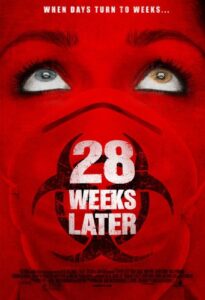
 28 Weeks Later, the sequel to the box office success and critically acclaimed 28 Days Later (2002), directed by Juan Carlos Fresnadillo (Intruders), seemed like it was destined for failure before it even began. With the relative newcomer replacing the seasoned Danny Boyle in the director’s chair and without the help of screenwriter Alex Garland, 28 Weeks Later could have easily been looked at as a cash grab, looking to earn a quick buck off of name association alone, while coming at the expense of a lesser story or one that was poorly executed. However, that was far from the case. While not as crisp or innovative as the original, 28 Weeks Later quickly established itself within the franchise, while also becoming a standalone film in its own right.
The film begins with Alice (Catherine McCormack – Spy Game, The Tailor of Panama) and her husband, Don (Robert Carlyle – Trainspotting, The Beach), in their countryside home. They have recently escaped the Rage Virus and now live in a small commune on a secluded piece of land, with no neighbors for miles. The couple’s two children, Tammy and Andy, are safely living outside of the country, having escaped the outbreak of the virus in Britain.
One evening, a young boy arrives at Alice and Don’s door. Though he is unaffected, a horde of infected has chased him through the fields and covered foliage to the front of Alice and Don’s home. Soon enough, the home is swarmed with the infected. Don manages to escape the house, but Alice is unable to do so. The two make eye contact when Alice looks out the third-floor window. Don has only a few short moments to plan his next move. He must decide if he’ll go back inside to try to save Alice or if he’ll run like hell without looking back. He chooses to save himself.

A timeline of credits scrolls across the movie screen, quickly giving a timeline of events between where 28 Days Later left off and where 28 Weeks Later picks up. Fifteen days after the outbreak, mainland Britain is quarantined. Twenty-eight days after the outbreak, the rage virus has destroyed mainland Britain. After five weeks, the infected have starved out. After 24 weeks, reconstruction has begun. Our story begins four weeks later. Tammy and Andy are reunited with Don, pressing their father about what happened to their mother. Their father’s details are murky. He fills in the gaps of their mother’s death with lies.
We learn that military and diplomatic forces are responsible for protecting and repatriating citizens. Amont those include of a young Jeremy Renner (The Hurt Locker, The Town). 28 Weeks Later introduced him as a sharp, down-to-earth, gritty sharpshooter, traits and skills that he carried with some of his most notable future roles, most notably Hawkeye in The Avengers universe, William Brandt in the Mission: Impossible franchise. Renner plays Doyle, a respected and skilled soldier who scans the nighttime sky from city highrises, protecting the city as a first line of defense against any new infected.
Our first interaction with Doyle is witnessing him and his team during a “Code Red” after a Rage Virus-infected human is found within the confined city. A Code Red involves corraling all the survivors indoors, turning out the lights, and staying quiet. By the time the military realizes it, it is too late to separate the infected from the non-infected. Doyle and the other soldiers are ordered by Commander Stone’s (Idris Elba – Beast, Molly’s Game) failsafe plan to shoot at anyone, regardless of whether they appear infected or not. Doyle is not okay with the command. After gunning down more than a dozen innocent civilians, it becomes too much. We gain a firsthand glimpse of how human nature reveals that it is only as stable as it can be in such uncertain and threatening circumstances. Doyle abandons his post and, instead, focuses his attention on leading a group of unaffected individuals, including Tammy, Andy, and epidemiologist Scarlet (Rose Byrne – Insidious, The Place Beyond the Pines), who had previously expressed concerns about the possibility of a new outbreak.

28 Weeks Later introduced and, possibly, inspired new elements of what an infected person could do. The Walking Dead television series was still very much like a George A. Romero Night of the Living Dead-type film, whereas 28 Days Later and 28 Weeks Later showed the potential of what films, television series, and video games could do with, for lack of a better word, rapid zombies. While watching the television series The Last of Us (based on the popular video game), I noticed something that felt heavily influenced (in a good way) by the uniqueness of 28 Weeks Later. This was especially appreciated in what has become a highly competitive and oversaturated market for this genre.
Overall, 28 Weeks Later was more than a worthy sequel. Without Boyle and Garland behind the direction and story, it felt different. Usually, I would not be a fan of that (the most drastic example of this is the differences between Mission: Impossible and Mission: Impossible II), but it worked here. It would have been challenging to maintain the same continuity, regardless, given that 28 Weeks Later is set in full aftermath mode, following the original’s story and conclusion.
Plot 8.5/10
Character Development 7.5/10
Character Chemistry 7.5/10
Acting 8.25/10
Screenplay 8.75/10
Directing 9/10
Cinematography 10/10
Sound 10/10
Hook and Reel 9/10
Universal Relevance 8.5/10
87%
B+
Movies You Might Like If You Liked This Movie
- 28 Days Later
- World War Z
- Resident Evil: Extinction
- The Crazies
- Mad Max: Fury Road