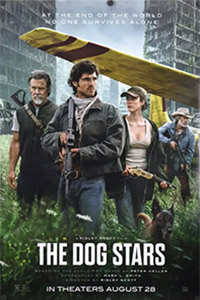
 Much has been made of Ridley Scott’s (Prometheus, Robin Hood) films in the last decade or so as being a far cry from those earlier in his career. Highly anticipated, high-budget films such as House of Gucci, The Last Duel, Gladiator II, and Napoleon have failed to deliver either critically or financially. While three of the films turned a profit, The Last Duel grossed just $30 million off a $100 million budget, though it was the highest-rated of the four on Rotten Tomatoes (critics), IMDB, and Metacritic. I saw all four in the theater. I thought The Last Duel was great, Gladiator II was good, and the other two were terrible. The budget for his most recent film, The Dog Stars, was around $80 million, similar to House of Gucci and The Last Duel. Based on its audience and critics’ scores (40%, 71% on Rotten Tomatoes) and opening-weekend box office gross of just $8 million, The Dog Stars appears to be well on its way to being a massive flop. This will be a shame as it’s a pretty good, albeit flawed, film. Continue reading The Dog Stars (2026)
Category Archives: Post-Apocalyptic
28 Years Later (2025)
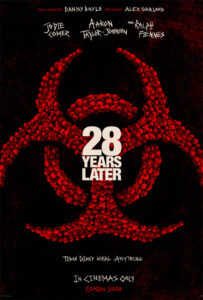 When director Danny Boyle (Slumdog Millionaire, 127 Hours) and screenwriter Alex Garland (Ex Machina, Civil War) teamed up for the 2002 film 28 Days Later, little did we know what a cultural phenomenon this under-the-radar, “Zombie if they were infected with Rabies” story filmed on an $8 million budget would become. Nor did we know just how well Boyle and Garland would complement each other, as director and screenwriter, respectively. Having become a timeless film that ignited a quarter century of zombie fiction movies, television shows, books, and video games, 28 Days Later modernized this horror sub-genre with its “what if the infected zombies moved at warped speed rather than at a snail’s pace” question.
28 Weeks Later (2007)
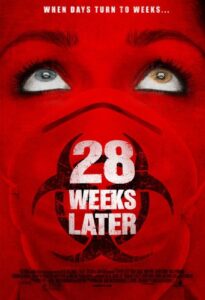 28 Weeks Later, the sequel to the box office success and critically acclaimed 28 Days Later (2002), directed by Juan Carlos Fresnadillo (Intruders), seemed like it was destined for failure before it even began. With the relative newcomer replacing the seasoned Danny Boyle in the director’s chair and without the help of screenwriter Alex Garland, 28 Weeks Later could have easily been looked at as a cash grab, looking to earn a quick buck off of name association alone, while coming at the expense of a lesser story or one that was poorly executed. However, that was far from the case. While not as crisp or innovative as the original, 28 Weeks Later quickly established itself within the franchise and became a standalone film in its own right. Continue reading 28 Weeks Later (2007)
28 Days Later (2002)
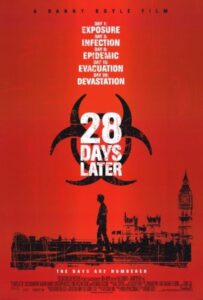 The moviegoer is in for a treat each time when either Danny Boyle or Alex Garland is involved in a project. Whether it be Boyle with a timeless filmography of directing credits that include Sunshine, Trainspotting, Slumdog Millionaire, and 127 Hours, or Garland’s vision with outside-the-box, ahead-of-his-time instant classics, such as Annihilation, Ex Machina, or Civil War, you can be confident you will be thinking of the film long after its view. 28 Days Later was the first time the two teamed up (Boyle as director, Garland as screenwriter). They struck a perfect accord of a tense, suspenseful, and foreboding film, painting a grim picture of what humanity could look like under the direst of circumstances.
Army of the Dead (2021)
 Of all of the movies that have been released since the start of the March 2020 COVID-19 pandemic, Army of the Dead is the one that I Of all the films released since the start of the March 2020 COVID-19 pandemic, Army of the Dead is the one I watched at home that I most wished I had seen in the theater. As I watch this movie a week ahead of A Quiet Place II (a movie that should truly signify a return to the movie theaters), I almost wish I hadn’t had the option to watch Zack Snyder’s (Batman v Superman: Dawn of Justice, 300) on Netflix. I intended to go to the theater this weekend to see this film, only to see it sitting there as an option to stream with my Netflix subscription. It was both a blessing and a curse. Free is excellent, as is the ability to play and pause a movie as you see fit. But it is hard to beat the in-theater experience of a film meant to be watched on the big screen.