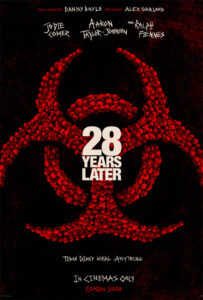
 When director Danny Boyle (Slumdog Millionaire, 127 Hours) and screenwriter Alex Garland (Ex Machina, Civil War) teamed up for the 2002 film 28 Days Later, little did we know what a cultural phenomenon this under-the-radar, “Zombie if they were infected with Rabies” story filmed on an $8 million budget would become. Nor did we know just how well Boyle and Garland would complement each other, as director and screenwriter, respectively. Having become a timeless film that ignited a quarter century of zombie fiction movies, television shows, books, and video games, 28 Days Later modernized this horror sub-genre with its “what if the infected zombies moved at warped speed rather than at a snail’s pace” question.
28 Years Later reunites Boyle and Garland after the two each sat out of the series’ second film, 28 Weeks Later, though they each served as executive producers. 28 Weeks Later was a worthy sequel to 28 Days Later. I liked it a lot. It’s not as if Boyle and Garland dismissed the sequel, but they were able to dance around it deftly, which was relatively easy to do considering the 27-and-a-half-year timeline between those two films. The bleakness of all three films remains the same, as does the gritty film style. What separates the two Boyle/Garland films from 28 Weeks Later is the character development. We feel a strong connection to the characters in the Boyle/Garland films. Even the conflicted antagonists bring elements that make us curious about their character arcs. 28 Weeks Later was a terrific film. It just didn’t leave us with as much to ponder as the other two movies. Like 28 Weeks Later, 28 Years Later will leave you thinking about it far after you watch, as excited to revisit it as you were the first time.
28 Years Later is far more thought-provoking than all three films. While it does prompt questions such as, “What would happen if the infected evolved? In addition to their speed, what would happen if they became stronger and smarter? What if there was an alpha?” However, it also poses questions, like, “How have humans adapted to this ever-present threat, now that it has been nearly three decades?”, “What survival skills have the uninfected developed this ever-present threat?”, or “What about children who have been born since the outbreak who have either never seen an infected or have grown up needing to look behind their backs every step of the way?”

28 Years Later starts as a post-apocalyptic father-son journey with father Jaime (Aaron Taylor-Johnson – Nocturnal Animals, The Wall) and his 12-year-old son, Spike (Alfie Williams), as the two travel from their home on an island to the mainland via a causeway, which allows for travel during low tide, and also keeps them safe at home during the high tide. While the pair seeks to gather the needed supplies as their reason for travel, it is common practice for a young person to experience this rite of passage at the age of 15 or 16. Spike goes through it at a younger age because Jaime believes he is ready. The causeway is a particularly neat plot device, as those who don’t make it back to the island before high tide must stay on the mainland until the next low tide. This part of the film is designed to provide the jump scares and exciting combat sequences between the pair and the infected they encounter. It also serves to show us the ever-evolving, time-tested relationship between father and son.
While the film asks more questions than it answers (in a good way), its plot is relatively straightforward. Jaime’s wife and Spike’s mother, Isla (Jodie Comer – The Bikeriders, The Last Duel), is ill and bedridden. This story serves as the basis for our film. Isla needs the services of Dr. Kelson (Ralph Fiennes – Conclave, The Return), who, conveniently, lives on the mainland. What is Isla’s ailment? What is the cure? And why does only Dr. Kelso have it? Those questions are unimportant. What is essential is finding Dr. Kelso, knowing they’ll be vulnerable the whole time to the infected.
28 Years Later is the most divisive movie of the franchise. While each was received well critically (Days: 87%, Weeks: 73%, Years: 88%), the differences in audience scores for Days (1%) and Weeks (7%) were much closer than the 25% difference with Years. There were many (a majority?) fans of the franchise expecting, or at least hoping, that the latest installment would follow the formula established by the first two films. That didn’t happen and may have resulted in poorer-than-expected audience scores. However, when examined from a storytelling lens, it would have been a disservice to do so. The difference between 28 Days and 28 Weeks is approximately half a year. The difference between 28 Weeks and 28 Years is 27 and a half years. It would have been a waste not to evolve the species as it adapted to this threat and an ever-changing society. Boyle and Garland weren’t going to tell a linear sequel of their first film, regardless of whether we wanted them to or not.

28 Years Later is a critic’s film. Many filmgoers walked away annoyed, thinking it was one of the worst films of the year. I not only thought it was great, but I’m also tempted to rewatch it while it’s still in theaters. The movie didn’t “follow the rules” of its two predecessors. At first, it did, but then it transitioned to a more humane, coming-of-age story. Those who weren’t looking for a film that differed significantly from the other two or weren’t prepared for a movie of such a tonal shift could easily be disappointed. Although I didn’t see it on opening weekend, I went into my viewing with nothing more than having watched the trailer once or twice and knowing it had high reviews from critics. It was enough to know I was likely to have a pleasant theatrical experience, regardless of the direction it led me. I was correct, except for the final two minutes. IYKYK. It’s not that the last two minutes were unexpected. It’s not that it left us with a cliffhanger. Instead, it was such a surprising cliffhanger that some might think it ruins the entire film.
With 28 Years Later: Bone Temple (upcoming sequel set for January 26 release) already filmed, and another movie already in the works, what I thought might be an incredible closing chapter of an innovative trilogy, now looks as if it might evolve into an “overextending your invite to a party” franchise of sequels, prequels, and spinoffs. If that happens, I hope they continue to create characters and tell stories that pique our curiosity about these future projects, just as we were with these first three films.
Plot 8/10
Character Development 8/10
Character Chemistry 8/10
Acting 8.25/10
Screenplay 9.25/10
Directing 9.5/10
Cinematography 9.5/10
Sound 9.5/10
Hook and Reel 9.5/10
Universal Relevance 9/10
88.5%
A-
Movies You Might Like If You Liked This Movie