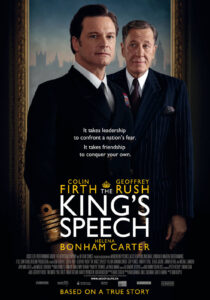
 The King’s Speech is a true story based upon how King George VI became the King of England after his father, King George V, died and his older brother David decided to abandon the throne to be with the woman he loved. George VI (aka Bertie to his closest friend) reluctantly takes over as King of England despite his stammering problem and utter fear of speaking in public.
To help overcome his disability, Bertie (Colin Firth – A Single Man, The Importance of Being Earnest) tries various techniques and visits numerous specialists. It is not until the King meets speech therapist Lionel Logue (Geoffrey Rush – Shine, Frida) that he begins to see progress. The two are very different from each other. The King is cold, aloof, often highly stressed, and short-tempered. It makes him unlikeable at times. On the other hand, Lionel is charming, friendly, funny, and patient. You like him from the moment you meet him. The contrast between the two characters makes them work well together.
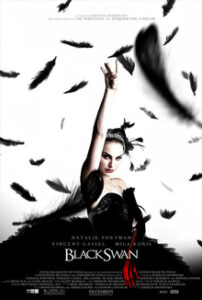 Swan Lake director Thomas Leroy (Vincent Cassel –
 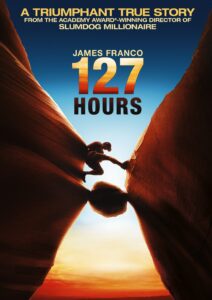 After seeing an episode of I Shouldn’t Be Alive a few years ago that showed the story of Aron Ralston, the adventure seeker who got his arm pinned between a boulder and a rock wall and managed to survive, I didn’t know if there was a need for a full-length feature film. I figured that the only way that Danny Boyle’s (Slumdog Millionaire, Yesterday)127 Hours would be able to affect me was if there was a masterful lead acting performance, some stylish directing, or a combination of the two. Fortunately, that was precisely what happened.
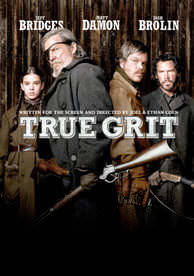 I am the first to admit that I am not as big a fan of Joel and Ethan Coen-directed movies as most people are. While I did enjoy Fargo (1996) and A Single Man (2009), I wouldn’t say I liked Miller’s Crossing (1990) and Barton Fink (1991). While I thought No Country for Old Men was pretty good, it was not close to being the best movie from 2007. Then there are the other Coen-directed movies I would prefer to see. These include Burn After Reading (2008), The Ladykillers (2007), Intolerable Cruelty (2003), or O Brother, Where Art Though? (2000). I appreciate a good Western. Once True Grit was nominated for a Best Picture Academy Award, it became a no-brainer that I saw the movie, despite my reservations about the Coens.
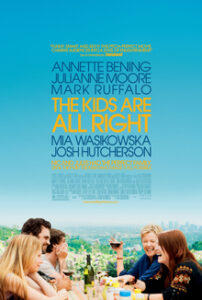 Lisa Cholodenko’s critically acclaimed 2010 film The Kids Are All Right shows that the rawest of human emotions cannot be limited to age, race, gender, disability, social status, or, as is the case in this movie, sexual orientation. In this movie, Nic (Annette Bening –