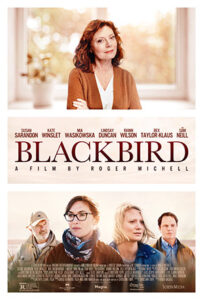
 In my two most recent reviews (Little Children, Ammonite), I sang the praises of Kate Winslet, calling her the world’s most talented movie actress over the last 25 years (1995-2020). With seven (soon to be eight with Ammonite) Oscar nominations, only Meryl Streep (11) has more during that time. I almost ventured to say she hadn’t taken on the wrong role then, but then I remembered she lent herself to the Divergent series, which I don’t fault. Though a movie like Divergent doesn’t need an actress of Winslet’s caliber to succeed, it is an opportunity to earn a lucrative payday. As a result, she can take on roles in more independent projects. With that said, I may have jumped the gun a little in my reviews of Little Children and Ammonite. I didn’t know Roger Michell’s (My Cousin Rachel, Changing Lanes) melodramatic Blackbird would soon water down her stellar filmography.
Category Archives: Year of Release
Little Children (2006)
 Little Children is a somewhat misleading title for a movie that has little to do with children or anyone physically small. While a couple of kids appear in this movie, they are nondescript and serve more as props than anything else. The leads are all middle-aged adults, though their undisciplined, erratic behavior suggests otherwise. The protagonists act as entitled brats, while the antagonists are fundamentally flawed. It becomes clear we are on a collision course between everyone involved in a film set in present-day New England, but it could just as well be any town in America.
Ammonite (2020)
 Ammonite, Francis Lee’s (God’s Own Country) tells the familiar of something uniting us all: the internal need to find human connection, even when we externally live a life that suggests otherwise. We often seek out other humans to fulfill some of our needs inside of us, though we often have different capacities. As I write this review during the Coronavirus pandemic, this innate truth could not be more evident. The main difference between now and the past is that we can connect with others through face-to-face video technology, phone calls, text messages, email, social media, and other platforms. But in 1840 Europe (the time and setting of Ammonite), the person had to be physically near you, outside of the occasional letter that might or may not arrive in the mail. There certainly is real-time interaction if you and the other person are in the exact location. Our connections also aren’t authentic, and we live a fabricated existence because it beats being alone. So when we can connect with someone (on whatever mutually agreed upon level), it quickly becomes something we don’t want to let go of. And that is essentially the story of Ammonite.
The Cider House Rules (1999)
 The best part of The Cider House Rules, the 1999 film by director Lasse Hallström (An Unfinished Life, Chocolat), is the sweet, uplifting score from composer Rachel Portman. When a movie’s score is the best thing you can say about it, that’s not always a good thing. That said, some excellent movie scores help make a good movie great or a great film near perfect. Examples that come to mind include Jaws, Rocky, Sicario, Jurassic Park, The Last of the Mohicans, Drive, The Social Network, Halloween, Far and Away, The Empire Strikes Back, and Braveheart, to name a few. Each is a movie I would consider, at worst, a B+ movie. Though a lower score likely wouldn’t change my impression of any of these films, one of the first three or four things that come to mind is the score. When I think of The Cider House Rules, I immediately think of Portman’s beautiful, Oscar-nominated score. However, unlike the movies above, its great score doesn’t make it great. An A+ score probably takes this C+/B- movie up to a B.
Unhinged (2020)
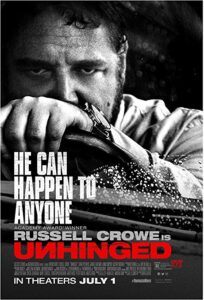 Deranged. Aggressive. Exorbitant. Implausible. Unhinged. Riveting. Adrenaline pumping. Wildly entertaining. Worthwhile Unhinged. Many adjectives describe Russell Crowe’s (Boy Erased, A Beautiful Mind), but words like well-crafted, consistent, or coherent don’t fit. It’s a diverting 90-minute escape from the cruel reality of 2020, and for that reason alone, I recommend it more than I would during a typical year. Starting with the film’s first scene, director Derrick Borte (American Dreamer, London Town) shows you the world he’s created around his leading character while setting the mood for what will be a relentless ride.