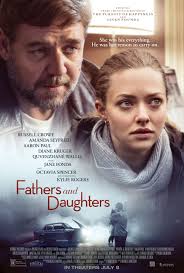
 Sometimes, when I’m at home looking for something to watch, I’ll say an actor’s name to my voice-activated remote control. After recently rewatching and reviewing 3:10 to Yuma, I wanted to see what other Russell Crowe (Gladiator, Cinderella Man) movies I might want to rewatch or see for the first time. When I saw Fathers and Daughters, a movie I had never heard of before, I decided to play the trailer. Within 30 seconds, I stopped the trailer. I had been teased enough to want to watch the movie without knowing more about it. I didn’t need to read any reviews, which may have turned me off. I saw it was a relationship movie centered on a past traumatic event involving Crowe. That was all I needed.
Category Archives: Year of Release
A Perfect World (1993)
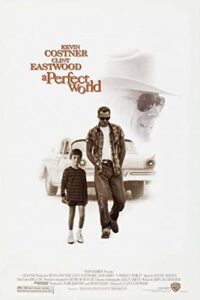 David Mackenzie’s critically acclaimed Hell or High Water, a 2016 movie nominated for Best Picture, reminded me of a quiet, subdued gem from 1993 that undoubtedly inspired a director just entering his prime. Clint Eastwood (Mystic River, Million Dollar Baby) was fresh off Unforgiven (a movie that earned him his first Best Director Oscar win as well as Best Picture of the Year) and the critically acclaimed, equally fan-adored In the Line of Fire. A Perfect World was Eastwood’s third movie between 1992 and 1993, the most successful two-year period of the most exceptional director/actor combination in cinema history.
3:10 to Yuma (2007)
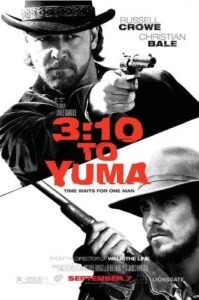 The Western genre is dying. Gone are the days of John Wayne, Clint Eastwood, et al., and the era of Westerns in the 1950s, 1960s, and 1970s. Once a staple in American cinema, those films are now few and far between. Years could pass before a good Western connects with critics and audiences alike. Unforgiven reset the standard in 1992, connecting with critics and audiences alike while earning nine Oscar nominations and taking home four, most notably for Best Picture. Others have followed. Appaloosa, Hostiles, True Grit, Tombstone, and Open Range were big-budget movies that hit the screen with reckless aggression. True Grit was the most successful with critics (10 Oscar nominations, but no wins), but even its success pales in comparison to Unforgiven.
John Q (2002)
 What was Denzel Washington thinking? Fresh off roles in 1998’s The Hurricane (Academy Award Winner – Lead Actor), the nationally recognized 2000s Remember the Titans, and 2002’s Training Day (Academy Award Winner – Lead Actor), Denzel was arguably at the peak of his acting career. He likely commanded (or was close to it) more guaranteed money per film than any other actor in America. He was probably receiving dozens of roles at a time. And yet he chose to accept the lead role in unproven Nick Cassavetes’s (Alpha Dog, She’s So Lovely) John Q.
American Beauty (1999)
 Lester Burnham (Kevin Spacey –The Usual Suspects, Se7en) isn’t your usual man going through your typical midlife crisis. A man going through a midlife crisis might quit his job, buy a sports car, cheat on his wife, long for a life with no responsibility, or obsess compulsively over things he can’t have. But all of these things at once? Maybe. But it’s less likely for sure. Sam Mendes (1917, Revolutionary Road) is a well-known director, even though he had directed only eight movies (as of 2020) and earned just one Oscar nomination before that year. But his film struck an accord, and he took home the two biggest trophies of the year for someone in his profession: Best Director and Best Picture for his debut feature-length film, 1999’s American Beauty.