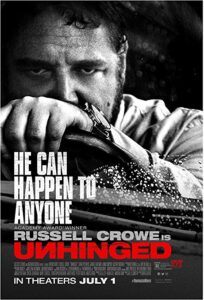
 Deranged. Aggressive. Exorbitant. Implausible. Unhinged. Riveting. Adrenaline pumping. Wildly entertaining. Worthwhile Unhinged. Many adjectives describe Russell Crowe’s (Boy Erased, A Beautiful Mind), but words like well-crafted, consistent, or coherent don’t fit. It’s a diverting 90-minute escape from the cruel reality of 2020, and for that reason alone, I recommend it more than I would during a typical year. Starting with the film’s first scene, director Derrick Borte (American Dreamer, London Town) shows you the world he’s created around his leading character while setting the mood for what will be a relentless ride.
If the trailer for Unhinged makes you think it’s an over-the-top movie about a man who’s let his road rage overwhelm him to the point where he can’t stop himself from exacting pent-up revenge, you only know half the story. While the trailer doesn’t reveal much, the story of The Man (Crowe) stems from something far beyond getting upset at fellow drivers on the road. It’s far more a revenge movie against one person The Man believes has wronged him than a man angry at society. Sure, he doesn’t like anyone, but it’s far more personal than Michael Douglas’s portrayal as D-Fens in the comparable Falling Down. While both movies are excessive in the points they make, Falling Down is far more original, and its lead character is far more relatable than Unhinged’s The Man.
The best time to watch this film is after a bad day, not before you head into rush-hour traffic. Grab a glass of wine, beer, or a double of your favorite liquor before plopping yourself onto your recliner and preparing for 90 minutes of exaggerated fun. Fun is too loose a term. It’s fun for us. It’s certainly not fun for anyone in this, most notably The Man, the woman he terrorizes, and all of New Orleans that stands in his way.

The main target in his path of destruction is Rachel (Caren Pistorius – The Light Between Oceans, Denial), a woman in the wrong place at the wrong time. Stuck behind an old truck at a local stoplight, an already agitated Rachel (she’s continually running behind time for her work appointments) lays on the horn a little too hard to grab the attention of the driver in front of her after the light turns green. The Man, unknown to her, pulls up next to her at the following stoplight and asks Kyle, her upper-elementary school son, who is sitting in the backseat (he seems a little too old to have to sit in the backseat, but maybe that’s just me), to roll down his window. The Man then asks Rachel why she was so heavy with the horn when she could have given a couple of quick taps to get his attention. She asks Kyle to roll up his window, but it’s stuck.
The Man continues his very polite conversation with Rachel and apologizes for not noticing the previous light had turned green, which caused her to grab his attention. He asks her to apologize for pressing the horn too loudly and too long when a simple tap would have done. She refuses to apologize, and this is where our crazy story unfolds. For most of the next hour, The Man harasses and torments Rachel and everyone important in her life. Before he meets Rachel, the audience knows what The Man has already done in the film’s first scene. He knows he’s a dead man walking. It’s just a matter of time before the local authorities can catch him. He has nothing to lose, so he goes all out to make her life a living hell for as long as humanly possible.

Something I liked about this movie is that The Man was angry, deranged, and unstable. Though we don’t know a lot of his backstory, Borte didn’t try to suggest that there was any mental illness involved with him. While he does not think coherently, Borte doesn’t try to justify The Man’s actions by hiding behind a defined mental illness. Of course, a sane person would not burn down the house of his ex-wife, and I understand that. An action like that goes far beyond anger. Perhaps he had an underlying, undiagnosed illness that had lingered with him for years, which caused him to act out. Or maybe there had been a series of recent life events (job loss, debilitating physical pain, opioid addiction, a history of domestic disturbances, restraining orders, divorce, and more) that had contributed to his mental well-being. We aren’t explicitly told what contributes to his anger, which leaves much of what we think about the character up in the air.
Crowe didn’t have to be the lead in this movie. A B-list Hollywood star (or lower) could have done the job just as well. Think of David Morse in Disturbia as an example. To play The Man, you don’t necessarily need to flex your acting chops. That said, I like it when actors step outside their norm, even when the role doesn’t require any acting training method. Crowe’s portrayal of The Man doesn’t hurt the movie, though. You would think someone with Crowe’s well-known reputation would keep viewers from seeing the character outside the actor. That wasn’t the case in Unhinged. Hiding behind the perplexing anger was an extremely down-on-his-luck, pill-popping man who, unfortunately, could be living right next door to you and, under the right circumstances, could crack. Crowe’s portrayal of The Man felt methodical throughout. Even during the most violent scenes that exposed his rage, he was still in command for the most part. He’d be hard-pressed to feel otherwise, even when things started spinning out of control. He was bold and unapologetic. While he knew his eventual fate, he was determined to go down on his terms.
Plot 6/10
Character Development 6/10
Character Chemistry 6/10
Acting 6/10
Screenplay 6/10
Directing 6/10
Cinematography 8/10
Sound 7/10
Hook and Reel 9/10
Universal Relevance 6/10
66%
D
Movies You Might Like If You Liked This Movie
- Joy Ride
- Breakdown
- Falling Down
- The Night Hunter
- Alone